 ktravelinfo
Choose the least tiring route to your hotel, not just the fastest route into Seoul
After immigration and baggage claim, it is easy to start asking everything at once: Where is AREX? Do I need to buy a bus ticket first? Is a subway transfer to a hotel in Myeongdong (myung-dong / 명동) really practical with a suitcase?
The best airport option is usually the one that gets you to your hotel door with the least effort—not simply the one that reaches Seoul first.
Dragging a large suitcase through stairs and transfer corridors on your first day can cost more energy than the fare you save. That does not mean you always need the most expensive option. If your hotel is right by a station, a train with no transfer may be the easiest choice.
Consider your hotel location, arrival time, travel party, and luggage together.
Check these five things before you fly
Save these details on your phone before leaving for Korea. Once you arrive, you only need to recheck anything affected by a flight delay or a hotel update.
- Your arrival terminal at Incheon International Airport (in-chun / 인천국제공항): Terminal 1 (T1) or Terminal 2 (T2)
- Your hotel’s Korean address and contact details
- Its check-in hours and whether late or self check-in needs separate instructions
- The nearest subway station or airport bus stop
- The real walking route from the station exit or bus stop to the hotel entrance
Do not rely on map distance alone. A route marked as 400 m may include a hill, stairs, or uneven pavement. With a large suitcase, the useful question is not “five minutes from the station,” but “how far is it from an exit with an elevator?”
Street View can help you check the hotel entrance, slopes, and how close a car can get. It also helps to decide on one backup plan, such as taking a taxi if you miss the bus.
A 30-second choice guide
| Your situation | Check this first |
|---|---|
| Near Hongik Univ. Station, light luggage, and keeping costs down matters | AREX all-stop train |
| Near Seoul Station (서울역), with a reserved seat and predictable travel time preferred | AREX Express Train |
| Your Myeongdong (myung-dong / 명동), Dongdaemun (dong-dae-mun / 동대문), or Gangnam (강남) hotel is near an airport bus stop | Airport bus |
| Three or four people, several large suitcases, or travelling with children or parents | A taxi or pre-booked transfer that fits both people and luggage |
| Rain or snow, plus a long walk from the station | A bus that stops near the hotel, or a taxi/transfer |
| You leave the airport late at night | Check remaining trains, night buses, and the route after getting off; otherwise compare a taxi or transfer |
1. AREX: count the trip after you get off the train too
AREX links Incheon Airport and Seoul Station (서울역). Its Express Train and all-stop train have different stops and tickets, so choose based on your hotel rather than the name alone.
Express Train: convenient for hotels near Seoul Station
The Express Train runs non-stop between the airport and Seoul Station and has reserved seating. It stops at both T1 and T2.
- T1 to Seoul Station: about 43 minutes
- T2 to Seoul Station: about 51 minutes
- Official adult fare: ₩13,000
- Reserved seats and free Wi-Fi
These are train journey times only. Add the walk to the platform and the wait for the next service. The Express Train requires its own ticket. AREX Express Train guide
It works well if you are staying near Seoul Station, want to sit down, or prefer not to risk road traffic. Even then, check which side of the station your hotel is on. For somewhere like Myeongdong (myung-dong / 명동), where you still need a subway transfer from Seoul Station, include the transfer corridor and final walk in your plan.
Getting to Seoul Station quickly is not the same as getting to your hotel comfortably.
All-stop train: check this first for Hongik Univ. Station
The all-stop train calls at intermediate stations, including Hongik Univ. Station (hong-dae-ip-gu / 홍대입구역). If your hotel is in Hongdae, you can get off there instead of continuing to Seoul Station. The Express Train does not stop at Hongik Univ. Station.
| Destination | From T1 | From T2 |
|---|---|---|
| Hongik Univ. Station | ₩4,650 | ₩5,250 |
| Seoul Station | ₩4,750 | ₩5,350 |
These are adult fares with a Korean transit card. A single-use transit card adds ₩100, plus a ₩500 refundable deposit. AREX all-stop train fares
The trip to Seoul Station takes about 59 minutes from T1 and 66 minutes from T2; some services take another two to six minutes. You can use a transit card or buy a single-use transit card from a station machine. AREX all-stop train guide
There are no reserved seats, so you may need to stand. It can be crowded at commuting times, making a large suitcase less convenient. Keep your luggage secure and do not block doors or aisles.
Still, crowding alone is not a reason to rule it out. Check whether it avoids a transfer, whether standing is manageable, and how far you need to walk after arrival. For a hotel just outside Hongik Univ. Station, it remains a simple option.
2. Airport bus: check the drop-off stop before anything else
For a Myeongdong, Dongdaemun, or Gangnam hotel with a large suitcase, the airport bus is often the first option worth checking. You can place luggage in the compartment under the bus and collect it at a stop near your hotel. If the bus stops close enough, it can avoid a subway transfer and stairs.
The trade-off is road traffic and the walk after you get off. A bus stop far from the hotel is not necessarily easier, even in rain. Airport Limousine’s Seoul city routes list an adult fare of ₩17,000; not every airport bus to Seoul has the same fare, so check the operator and fare for your own route. Airport Limousine fares
What to check before choosing a bus
- The name and location of the drop-off stop near your hotel
- The route number and operator serving that stop
- The boarding point at your arrival terminal, departure times, and last bus
- The walking route from the stop to the hotel entrance
- Ticket purchase and baggage rules
According to Airport Limousine, ticket offices and machines are on the first floor at T1 and basement level 1 at T2. Machines operate 24 hours, but that does not mean buses run 24 hours. Airport Limousine ticket purchase guide
If you use another operator, follow that route’s guidance. Do not assume a transit card is enough to board; check whether you need to buy a ticket first.
If a hotel listing says “two minutes on foot from the airport bus stop,” make sure it is the drop-off location for buses arriving from the airport on your route.
3. Taxis and pre-booked transfers: compare people and luggage together
A taxi or transfer can feel expensive when travelling alone. For a group, however, bus fares add up too. Four adults on a ₩17,000 bus cost ₩68,000 in total.
Do not assume that four people and four large suitcases will fit in one regular taxi. Confirm a vehicle can carry everyone and all luggage, then compare that vehicle’s total cost. A taxi or pre-booked transfer can be much easier with children or parents, several large bags, or a hotel far from a station. For a hotel in a narrow alley, also check whether the vehicle can reach the entrance.
Taking a regular taxi
The total taxi fare depends on the destination, traffic, tolls, and late-night surcharges. Check an estimate before leaving, but also check whether it includes tolls and any extra charges.
- Use an official airport taxi rank
- Keep the hotel’s Korean address ready to show the driver
- State the number and size of your suitcases, then confirm they fit
- If travelling late, check the surcharge for the vehicle type
See the Incheon Airport taxi guide for taxi ranks and vehicle information.
Choosing a pre-booked transfer
A pre-booked transfer lets you choose a vehicle for your group and luggage and arrange how to meet the driver. Check these conditions as well as the price:
- Passenger and suitcase capacity
- Flight-delay policy and free waiting time
- Meeting terminal, location, and contact method
- Whether tolls, late-night fees, and extra waiting charges are included
- Cancellation and change rules, plus customer-service contact details
- Whether the vehicle drops you at the hotel entrance or another point
Do not book based only on the phrase “transfer included.” Check exactly where you meet and where the driver takes you.
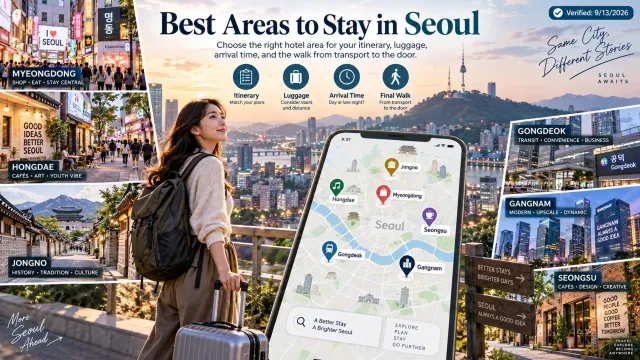
4. Myeongdong, Hongdae, Dongdaemun, and Gangnam: think by hotel area
Near Hongik Univ. Station
If your hotel really is close to Hongik Univ. Station, start with the AREX all-stop train. Going straight there without a transfer is a major advantage. If the hotel is farther away or in an alley, compare an airport bus that stops near it or a taxi. Taking the Express Train just to avoid crowds means travelling back from Seoul Station, so it is usually a poor fit for Hongdae.
Near Myeongdong or Chungmuro
With a large suitcase, first check the airport bus drop-off point near your hotel. You can transfer to the subway at Seoul Station, but a bus stop close to the hotel can mean less carrying. Even within Myeongdong, the final stretch differs between a hillside location and a main-road location, so check the address too.
Near Dongdaemun
A “Dongdaemun hotel” may be near Dongdaemun Design Plaza (dong-dae-mun di-ja-in peul-la-ja / 동대문디자인플라자), or closer to Dongmyo or Sinseol-dong. The best route can differ. Choose by the exact address and distance from the drop-off stop, not by the area name alone.
Near Gangnam, COEX, or Jamsil
An airport bus that stops near your hotel can reduce the burden of a subway transfer, but traffic can slow it down. Leave extra time if you have a show or dinner reservation on arrival day. If the bus stops far away or does not suit your arrival time, compare the real subway route and taxi cost too. Do not choose the bus just because you are staying in Gangnam; compare the full door-to-door journey.
5. For a late arrival, use the time you leave the airport—not your landing time
A flight landing at 10:30 p.m. does not mean you can board a bus at 10:30. Immigration, baggage collection, and the walk to the transport area all take time.
Check the last service against the time you expect to reach the boarding point with your suitcase.
For a late arrival, check three things together:
- Whether there is a train or night bus left from your terminal
- Whether you can reach the hotel from the drop-off point, or need another ride
- Whether the hotel can check you in at that time
A night bus existing is not the same as getting to your hotel easily. Even if its departure time works, include the wait and extra cost if the final walk is long. Check departure terminals and destinations in the operator’s route guide.
A night bus can work well when the time and drop-off point suit you. If there is no suitable service or the route to the hotel is complicated, compare an official taxi and a pre-booked transfer. Let the hotel know in advance if you expect to arrive late, and get its check-in instructions.
6. If you get stuck, ask briefly and show your screen
It is normal to be confused when buying a ticket or finding an exit in a new place. You do not need to solve every detail alone.
Ask airport staff at the airport, station staff at stations, and contact the hotel about the route around it or late check-in. Showing your address or map on screen is often easier than giving a long explanation.
- “Where should I get off for this address?”
- “Where do I board this bus?”
- “Which exit has an elevator?”
Save screenshots of the hotel’s Korean address, booking details, and contact number. You can show them even if your internet connection is temporarily unavailable. Saving a question in a translation app can help too.
7. The last 500 m: check the route to the hotel entrance one more time
The last 500 m can be harder than getting from the airport into Seoul. Once you have chosen a train or bus, trace the route from where you get off to the hotel entrance.
- For the subway, start from an exit with an elevator
- For a bus, start from the actual drop-off location
- Check for stairs and hills, and whether you could manage luggage and an umbrella in rain
- Confirm the building entrance and late-night access method
If the map is unclear, ask your hotel:
“I have a large suitcase. Which station exit or bus stop has the fewest stairs when coming from the airport?”
If the final walk feels too difficult, you can add a short taxi ride. Add that fare to your public-transport cost and compare it with a vehicle from the airport.
Choose the route that gets you comfortably to your hotel
For a hotel just by Hongik Univ. Station, start with the all-stop train. For Seoul Station and a reserved seat, consider the Express Train. If there is a stop near your hotel, check the airport bus first. With several people or a lot of luggage, compare the total cost of a vehicle that fits everyone.
Whichever option you choose, ask one final question: “Can I get to the hotel entrance comfortably while pulling my suitcase?” If the answer is yes, you do not need to take the option that everyone else takes.
Your first day of a trip is for arriving safely, not for pushing through. Leave yourself enough energy to settle in and look forward to Seoul.